Pomodoro for Writers: How to Beat Blank-Page Paralysis with Timed Sprints
Pomodoro for writers: learn how timed sprints beat blank-page paralysis, shut down your inner editor, and build a sustainable daily writing habit.

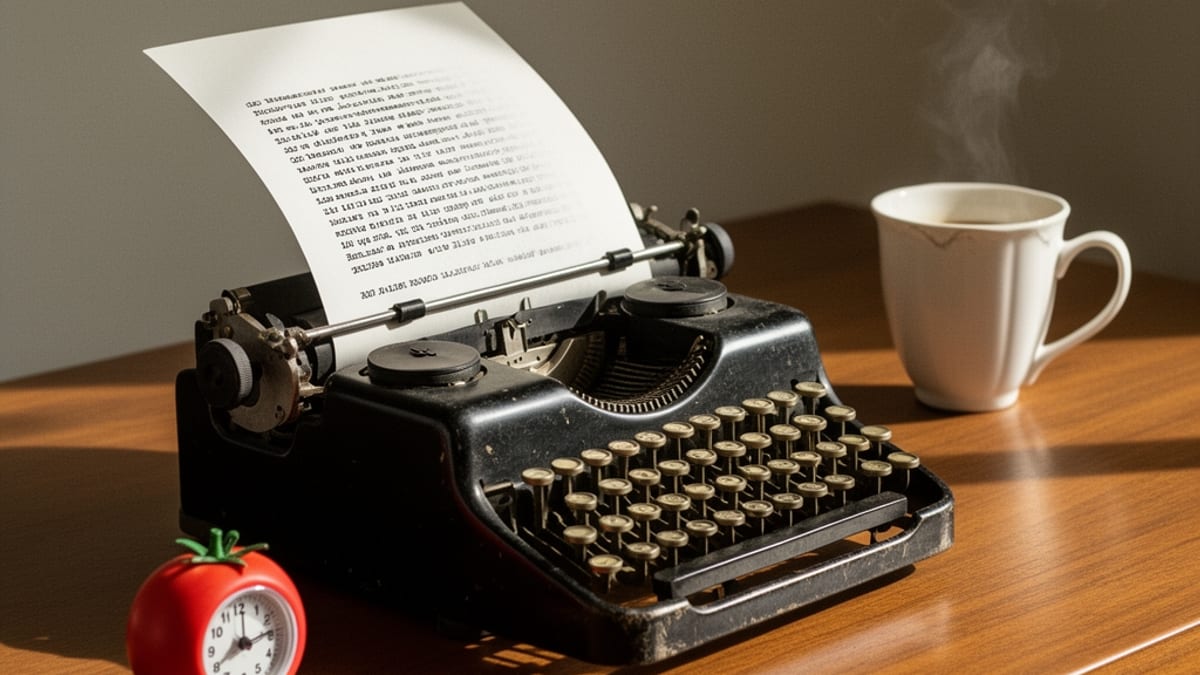
You open the document. Title at the top. Cursor blinking underneath. Ten minutes later, you've written and deleted the same sentence four times, checked one fact you didn't need yet, and somehow ended up comparing synonyms for a word that isn't even in a paragraph.
That's not laziness. It's a workflow problem.
Most advice on Pomodoro for writers stops at "Set a timer for 25 minutes and write." Helpful, but incomplete. Drafting, researching, revising, and polishing use different kinds of attention. If you treat them as the same task, the timer becomes another thing to resist.
Used properly, timed sprints can do something more specific: get you past blank-page paralysis, shut down your inner editor long enough to produce a draft, and make tomorrow's session easier than today's.
Why the "Binge Writing" Myth is Destroying Your Word Count
A lot of writers still believe the big lie: real writing happens in huge, sacred blocks. A cabin weekend. A free Saturday. A perfect four-hour stretch with coffee, silence, and inspiration on command.
In practice, waiting for ideal conditions usually means not writing at all.
Paul J. Silvia's work on writing productivity argues for scheduled, regular writing rather than waiting for large bursts of motivation or "feeling ready" [Source: APA Books]. The writers who produce consistently aren't guarding some mythical marathon session. They're the ones who sit down often, even when the session feels short and unglamorous.
That matters because the blank page gets scarier the longer you avoid it.
If your goal is "write a brilliant chapter," your brain hears risk. High stakes. Judgment. The possibility of failing in public, or at least in your own eyes. If your goal is "keep my fingers moving for 25 minutes," the stakes drop immediately. You're no longer trying to prove you're talented. You're trying to complete a sprint.
That shift sounds small. It isn't.
Strict time constraints can reduce the pressure that fuels writer's block because they lower the emotional cost of starting [Source: The New York Times, 2018]. You don't need to solve the whole article, chapter, or sales page. You just need to stay in motion until the timer ends.
And perfectionism hates motion. It prefers delay.
Blank-page resistance often shows up as fake productivity. Re-outlining. Renaming folders. "Just quickly" checking a source. The mind frames this as preparation, but it's usually avoidance wearing glasses. A visible timer disrupts that pattern. It creates a narrow, survivable container for imperfect work.
You stop asking, "Can I write something great today?"
You start asking, "Can I stay with the page for one sprint?"
Usually, you can.
How Pomodoro Cures Blank-Page Paralysis
The first gift of a timer is speed. Not sloppy speed. Protective speed.
When you're drafting under a countdown, you have less room to indulge the impulse to rewrite your first paragraph five times. That matters because drafting and editing compete with each other. The more you try to polish while generating ideas, the more momentum you lose. Nature has explicitly pointed to the value of separating drafting from editing in serious writing workflows [Source: Nature, 2018].
This is where Pomodoro works especially well for writers. It gives each mental mode its own lane.
During a drafting sprint, your job is not to judge. Your job is to produce raw material. The ticking clock helps you outrun the inner editor long enough to get words onto the page. Messy words count. Fragments count. Bracketed notes count. Momentum counts most.
I also like the "write or nothing" rule. Neil Gaiman has described a version of this approach: you don't have to write, but you can't do anything else. In a Pomodoro, that rule becomes powerful. Sit there if you want. Stare at the wall. But no email, no tabs, no phone, no "quick" research detour. Eventually, writing becomes the path of least resistance.
And then there's the scorekeeping.
Not every writer should obsess over word count, but words-per-Pomodoro can be motivating in a way daily totals sometimes aren't. Harvard Business Review has shown that small wins are one of the strongest drivers of motivation in creative work [Source: HBR, 2011]. Finishing one clean 25-minute sprint is a small win. Seeing that one sprint produced 320 words, or three decent paragraphs, or a solved transition, creates proof. You moved. The project moved. That's often enough to earn the next sprint.
The timer doesn't make writing easy. It makes it finite.
For blocked writers, that's often the difference that matters.
Adapting Sprints: Novelists vs. Journalists vs. Copywriters
"Writers" is too broad to be useful. A novelist gets stuck differently than a journalist. A copywriter faces different pressure than someone drafting a memoir. The sprint should fit the work.
For novelists and fiction writers, Pomodoro shines when the draft gets muddy. The messy middle. The chapter bridging two major scenes. The world-building section that keeps expanding instead of moving the story forward. Here, I like pure word sprints. Pick a scene objective and push. Don't stop to name the side character perfectly. Don't research whether a horse could realistically travel that distance yet. Keep moving. This is especially helpful if you're figuring out how to use word sprints for NaNoWriMo or testing the pomodoro technique for writing a book.
For journalists and non-fiction writers, the big danger is research sprawl. One source leads to another, then another, then suddenly your "writing session" has become tab management. The fix is strict separation: Research Pomodoro first, Drafting Pomodoro second. During the research sprint, gather links, quotes, notes, and structure. During the drafting sprint, no new tabs unless absolutely necessary. If something is missing, mark it and keep going. That separation protects the draft from being swallowed by curiosity.
For copywriters and marketers, the enemy is often endless tweaking. Headlines become a trap. So can opening hooks, CTAs, and product claims. Timers work here because deadlines sharpen decisions. Parkinson's Law applies brutally well to client work. If you give yourself all afternoon to write one landing page section, you'll use all afternoon. If you give yourself one focused sprint to produce options, then one separate sprint to refine, you stop pretending perfection happens by hovering over a sentence.
Different writing roles need different sprint labels. But the principle stays the same: match the timer to the cognitive job.
Creator sprint. Research sprint. Editor sprint.
Don't mix them if you can help it.
The "Mid-Sentence" Hack: Weaponizing the Zeigarnik Effect
This is the strangest writing habit I recommend, and one of the most useful.
When the timer rings, stop. Even if you're in the middle of a sentence.
Especially then.
Most writers feel the urge to finish the paragraph, tie the bow, close the thought neatly. But leaving the work slightly unfinished can make the next session dramatically easier. The Zeigarnik effect describes our tendency to remember incomplete tasks better than completed ones [Source: Psychology Today]. In writing terms, an open loop keeps the engine idling.
If you stop after wrapping everything up perfectly, tomorrow you restart from zero. New sentence. New transition. New momentum. If you stop in motion, your brain already knows where it's going next.
That's why you should resist the temptation to "just finish this bit." The unfinished line becomes a runway back into the draft. You sit down, read the last fragment, and continue almost automatically.
This also cures the dread of tomorrow's blank page. You're not facing a void anymore. You're resuming an interrupted thought.
One caveat: don't lose the ideas that spill out once the timer ends. During your five-minute break, jot any overflow in the lightest possible way. A sticky note. A scratchpad line. A bullet list in a separate note. Not a full drafting session in disguise. Something like:
- mention example from client meeting
- check quote attribution
- next section: objection handling
That's enough. Capture, then actually take the break.
The break is part of the method, not a reward for being good.
Structuring a Writing Session with TaskPomo
A writing session gets much easier when each sprint has one role. In TaskPomo , I like a three-phase setup that mirrors how real writing actually happens.
Phase 1: Outline/Research Sprint. Use the first 25 minutes only for structure, bullet points, source gathering, and deciding the shape of the piece. For an article, that means H2s, argument flow, and links. For a chapter, it might mean scene beats, conflict points, and questions you need answered. This sprint matters because it removes dozens of tiny decisions from the drafting phase.
Phase 2: "Ugly First Draft" Sprints. Usually two or three intervals. This is Creator mode. Backspace is mentally disabled. You are not cleaning. You are not checking whether the line is elegant. You are pushing material onto the page so the draft has mass.
I learned this the hard way writing landing pages for my consulting clients. I'd sit down to draft a Google Ads landing page and spend forty minutes rewriting the same opening sentence, trying to make it perfect before I'd even decided what the page needed to say. One afternoon I had three client pages due and I'd produced exactly zero usable copy in two hours. That was the day I forced myself to try ugly drafts inside a Pomodoro timer. I set 25 minutes, opened a blank doc, and typed the worst landing page I've ever written. Misspellings, placeholder headlines, a CTA that just said "button goes here." But when the timer rang, I had the bones of all three sections laid out.
The thing that surprised me was how fast the next sprint went. With the structure already on the page, I wasn't making decisions anymore. I was just filling in gaps and improving sentences. What had been a two-hour paralysis loop turned into roughly 75 minutes of actual output across three sprints. I started applying the same approach to blog posts, client proposals, even email sequences. The pattern held every time: separating the mess-making from the cleanup made both phases faster.
This is where most writers feel the biggest relief once they commit. Not because the draft becomes beautiful. It doesn't. It becomes real. And real is infinitely easier to revise than imaginary.
If I get stuck in this phase, I use placeholders aggressively. "TK statistic." "TK product name." "TK quote from interview." That tiny habit prevents a 20-minute detour every time I hit a missing detail. Journalists have used TK for years as a temporary marker for information to come later. In a timed writing sprint, it's gold.
Phase 3: Editing/Polishing Sprints. Now you switch roles. This is Editor mode, and it should be clearly separated from drafting. Tighten sentences. Cut repetition. Verify facts. Improve rhythm. Format. If you start editing too early, you choke the draft. If you never switch into editing mode, you ship mush. Separate phases solve both problems.
This role-switching approach is simple, but it changes the feel of a session. You stop asking one sprint to do everything. Each one has one job.
Common Pitfalls for Writers Using Timers
The most common mistake is getting derailed by fact-checking.
You hit a sentence that needs a date, a quote, a name, a product spec, or a reference. The old reflex is to look it up now. One search becomes five, and the sprint is gone. Use the TK method instead. Type TK where the missing piece belongs and continue drafting. Since "TK" rarely appears in normal prose, it's easy to search for later. This is one of the cleanest ways to maintain flow while still respecting accuracy.
Another mistake is skipping the break.
Writers do this because the draft finally feels warm and they don't want to interrupt it. I understand the instinct. I've ignored the timer too. But when you repeatedly skip breaks, the cost shows up later. Your sentences get flatter. Your decisions get fussier. You become strangely drawn to low-value tasks like formatting, tab-switching, or headline fiddling. Breaks help sustain attention and creative output over multiple rounds, which is exactly why they belong in the system [Source: HBR, 2011]. If you're using timed writing to avoid burnout, the rest intervals are not optional decoration.
Then there's the wrong interval length.
Twenty-five minutes is a strong default because it lowers resistance. It's short enough to start even when you don't feel ready. But it isn't sacred. If you're deep in a fiction scene or a highly focused analytical stretch, 50-minute intervals may serve you better. The key is honest matching. Use 25 minutes when starting is the hard part. Stretch to 50 when interruption itself becomes the problem.
If you're constantly bouncing off the timer just as you settle in, experiment. But don't use "I need a longer block" as a disguised excuse to wait for perfect conditions again.
Building a Sustainable Daily Writing Habit
The healthiest long-term shift is this: track sessions, not just word counts.
Word count can be motivating on good days and demoralizing on hard ones. Some sessions produce 1,000 rough words. Some produce 180 necessary ones. Some produce no visible words because you used the sprint to untangle structure. If you only measure output, you'll misread progress. If you track completed writing sessions, you protect the habit itself. And habits are what carry books, articles, newsletters, and client work across the finish line.
This fits what we know about small wins. Progress you can see, even at a modest scale, keeps motivation alive [Source: HBR, 2011]. A chain of completed sprints can be more psychologically durable than a single heroic day.
It also helps to guard your best mental hours for drafting. Most writers know, at least vaguely, when their brain is sharpest. Early morning. Late night. Right after lunch, if you're lucky. Put Creator sprints there when possible. Save lower-energy periods for editing, research cleanup, or formatting. The same 25 minutes can feel completely different depending on when you use it.
And yes, consistency beats intensity.
Silvia's core point still lands: regular scheduled writing outperforms waiting for large blocks of inspiration [Source: APA Books]. Even two Pomodoros a day can build a serious body of work over time. That's true for fiction writers thinking about time management, for freelancers trying to protect billable creative hours, and for anyone trying to make writing less emotional and more repeatable.
If you want one thing to do today, make it small and specific: set one 25-minute writing sprint, decide whether it's a Research, Creator, or Editor session before you begin, and when the timer rings, stop mid-sentence on purpose. Tomorrow's page will feel lighter. If you'd like accountability while you write, joining a focus room can make even a solo writing session feel less isolating.